
Read an interview with Milan Horváth, Deputy CEO of Eximbanka for Insurance
Your career includes experience in commercial banking, insurance, central bank and public finance. How do these different institutional perspectives translate into your time at Eximbanka?
My professional journey has allowed me to look at risk management from multiple perspectives – from commercial banking to insurance to the public sector. It is the insurance experience that is key in setting up risk protection tools for exporters. At Eximbanka, I use this knowledge to ensure that we are able to properly identify, price and manage the risks associated with exporting. The details play an important role – especially the quality of the contractual set-up, partner assessment and territorial risks, which often determine success more than the terms of trade themselves.
Eximbanka combines financing and insurance. In your opinion, what is the greatest added value of this combination for companies and where Slovak exporters are not yet using it to its full potential?
The biggest added value of insurance is the reduction of uncertainty in exporting. It provides companies with protection against both commercial and political risks, enabling them to enter new markets more safely. Yet many Slovak firms still do not use insurance as a strategic risk management tool. Often they see it only as an additional service, which is an untapped potential. The solution is to incorporate insurance into the export strategy from the outset – not just as protection, but as a tool that enables the company to grow, enter new markets and obtain better financing.
What are the key differences in the structuring and valuation of insurance for domestic versus foreign market-oriented projects?
Insurance plays a significantly larger role in foreign projects, as the risk environment is more complex – it includes territorial, political, currency and legal risks. It requires a detailed assessment of both the business partner and the country and an individual adjustment of the insurance cover. Domestic projects are more stable and predictable from a risk perspective, so the scope of insurance cover required is generally smaller. The key difference is therefore the level of uncertainty and the need to actively manage it through insurance.
What determines whether a company is a trustworthy partner for Eximbank? What weight do financial indicators, the experience of the company or the quality of its management have in this assessment?
In export insurance, a company’s credibility is the result of a comprehensive assessment. In addition to financial indicators, the history of the company, its export experience, the quality of its management and its ability to identify and manage risks are important. Transparency and quality of information about trading partners also play an important role. The overall risk assessment is always based on a comprehensive picture – not only the numbers, but also the behaviour and reliability of the firm.
Where do Slovak companies most often make mistakes before entering a foreign market – in the area of financial preparedness or in understanding and managing risks?
Slovak companies often underestimate the risks associated with entering a new market, such as payment discipline of partners, legislative environment or currency fluctuations. In terms of product and production capacity, firms are usually well prepared, but are weaker in terms of systematic risk management. They lack sufficient analysis of the market and development scenarios. This is where problems arise that can jeopardise the success of exports
What most often differentiates Slovak companies that are able to succeed on foreign markets in the long term from those that do not?
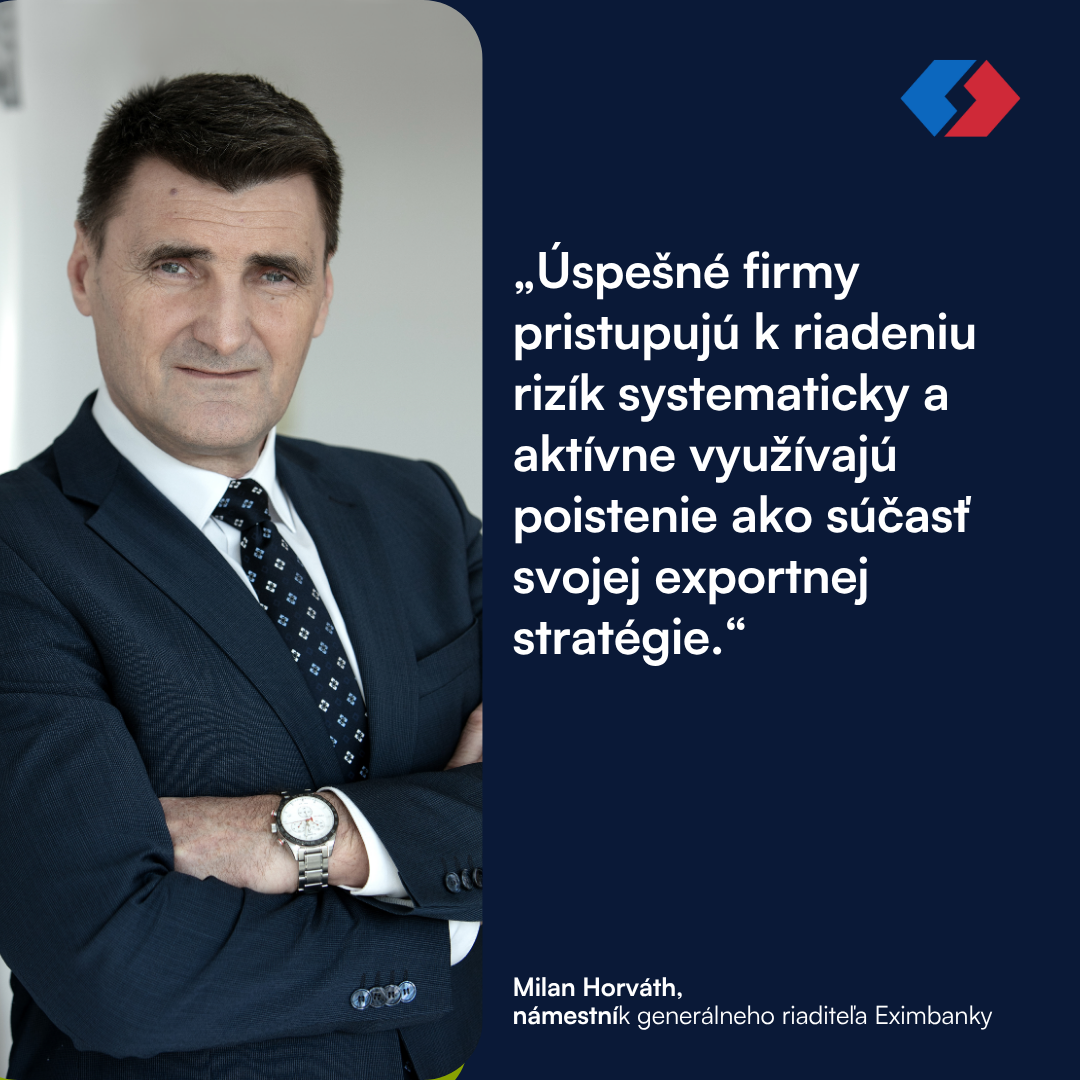
Successful companies take a systematic approach to risk management and actively use insurance as part of their export strategy. They diversify markets, monitor risk developments and build quality business relationships. At the same time, they realize that insurance is not just a protection, but a tool for stability and growth. Less successful companies often react only when problems arise and underestimate preventive risk management.
From the point of view of a person with experience from the Ministry of Finance of the Slovak Republic – by what should the success of state export support be measured in order to be really effective?
Export success should not only be measured by the volume of trade, but also by its quality and sustainability. What matters is whether firms can safely enter new markets, operate in them over the long term, sustain themselves and grow. The diversification of exports and their contribution to the economy, for example in the form of employment or higher value added, should also be monitored. So it is a broader view than just short-term results.
Author Filip Šandor
Keep up to date with export and foreign trade information on our Linkedin profile.
The interview was published on 18.04.2026