
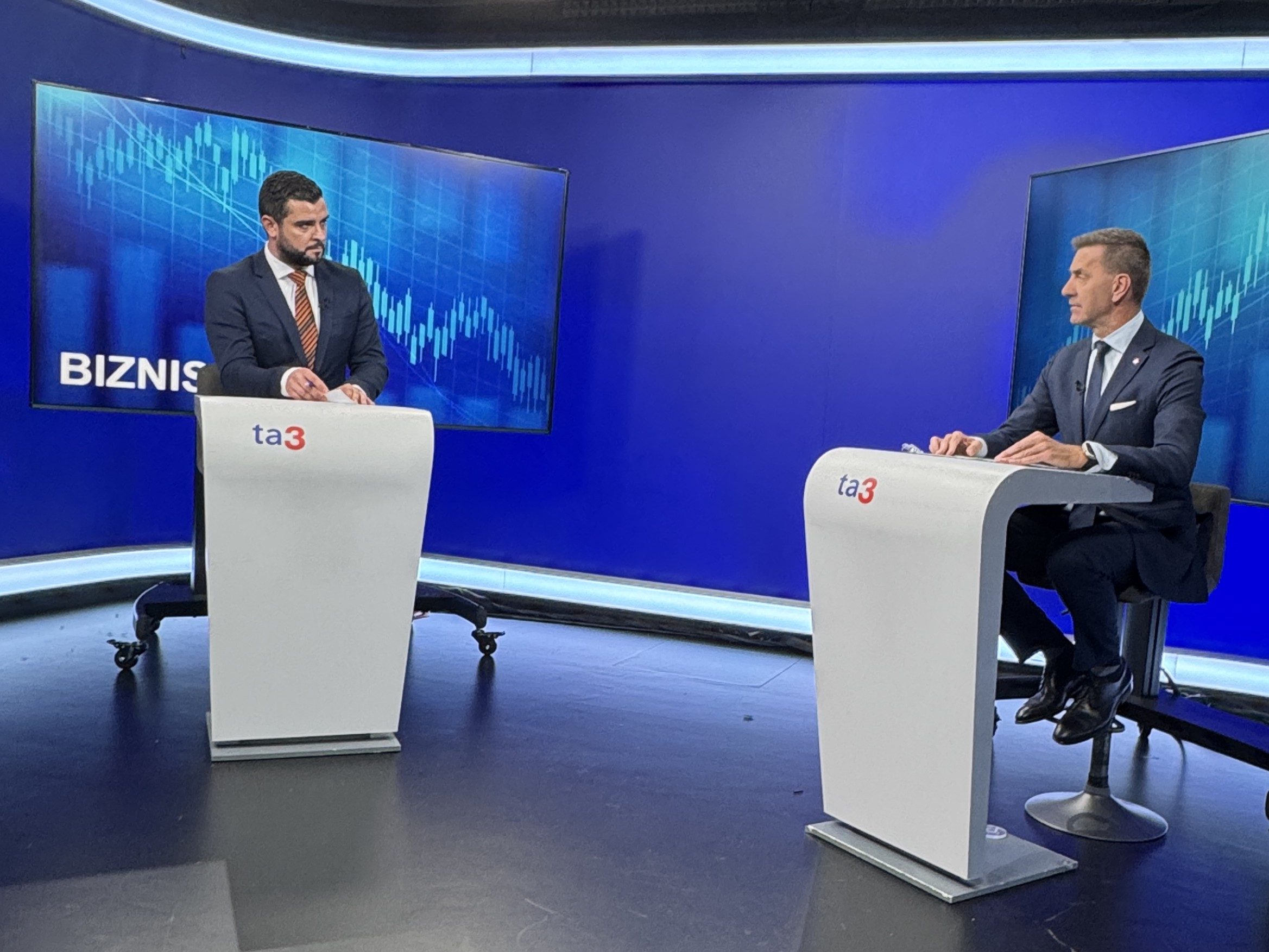
Interview with Rastislav Podhorec, CEO of Eximbanka, in Business with Miroslav Kohút on ta3 television.
Exports have been the engine of the Slovak economy for many years. However, geopolitical conflicts, tariffs and new trade barriers, as well as rising tensions between major powers, are changing the rules of the game for companies around the world. Can Slovak exports survive in the new reality? Where are the biggest risks today and where are the new opportunities. And what do companies need to do to succeed in a period of growing uncertainty.
My guest is Rastislav Podhorec, CEO of Eximbanka. Welcome, have a nice day.
Good day, thank you for the invitation.
Geopolitical tensions are indeed fundamentally changing global trade today. How does this uncertainty translate into the decision-making of Slovak exporters? ?
You are right, geopolitical uncertainty is one of the key factors influencing companies’ decisions on which markets to export to today. Whereas in the past companies made decisions mainly on the basis of economic indicators such as costs or expected revenues, today geopolitics is playing an increasingly important role in their decision-making.
Even if we take into account the tense geopolitical situation, are Slovak companies ready to operate in an environment of, for example, higher tariffs and in general in an environment of tougher international competition?
It’s a simple question, but the answer is more complex. We have different types of companies in Slovakia. A large part of them have so far operated mainly within the European Union, where the rules are clearer and more predictable. We know that almost 80% of Slovakia’s exports go to EU markets.
Then there are companies that have been operating for a long time in the international environment outside the European Union and are used to working with a greater degree of risk, uncertainty or competition. The question is therefore to what extent those companies that have so far been mainly oriented towards the European market are also prepared.
I think that Slovak companies are gradually starting to adapt and are watching the situation closely. We see it also among our clients who communicate with us and consult us on how to continue to operate in this new economic environment. There is no one universal answer, but companies that understand where the world is going are certainly more likely to succeed.
Staying with the global view, Europe is slowing down and companies are looking for new opportunities. Which regions do you see as the most promising for Slovak exports today?
Two years ago, the Slovak government defined in its programme declaration the countries and regions on which it wanted to place greater emphasis. It is interesting that these regions are now becoming very promising from a global perspective.
If I had to name them briefly, it is certainly Central Asia, that is, the countries of the former Soviet Union in the Central Asian region. These are countries that are located at important trade crossroads, which is also significant in view of the current problems in maritime transport. At the same time, they are growing in terms of production, market volume and demand.
Southeast Asia, such as Vietnam, Indonesia, Malaysia, the Philippines and Singapore, is also a very interesting region. This region is increasingly seen as an alternative to China and offers an interesting business environment. We also perceive among colleagues from other export agencies that companies are looking at Southeast Asia very positively.
The Middle East is also promising, although we have seen increased uncertainty there in recent months. However, it is still a region where there are large investments and large-scale infrastructure projects.
Another important region is Africa. It is a continent with great future potential in terms of population growth, investment and demand. We see interest there from the European Union, China and the United States. The European Union also has support instruments, such as the Global Gateway, which may also be of interest to Slovak exporters. From a European perspective, the Western Balkans are also important for us. Slovakia has a good position there, and it is a region that has the prospect of moving closer to the European Union, which is also linked to significant investment opportunities.
Slovakia is a strong industrial economy and yet many companies still operate mainly as subcontractors. Why have we not yet succeeded in perhaps building our own strong export brands to a greater extent?
The subcontracting model developed significantly in Slovakia around 2000 and brought with it significant economic growth. Slovakia has benefited from this model for many years and it is thanks to it that its industrial position has been strengthened.
Today, however, we see that this model is gradually reaching its limits. Many companies are part of subcontracting chains that are not easy to get out of. They have set clear relationships, rules and buyers, which makes the transition to the new environment difficult.
At the same time, when Europe slows down, companies must look for the next step in their development. But building a brand, entering new markets or moving up the value chain takes time, courage and investment. The solution lies mainly in innovation and investing more in development.
What decides today whether a Slovak company will be able to establish itself outside its traditional markets, for example outside the European Union? What determines success or failure today?
The basis for success in any market is first and foremost a quality and competitive product that the company has the real ability to sell. However, the product alone is not enough. If a company wants to enter a new market, it must study the region it is targeting very well.
To znamená poznať miestny trh, jeho mentalitu, kvalitatívne požiadavky, legislatívu aj obchodné zvyklosti. Firmy musia byť pripravené investovať čas a energiu do toho, aby daný región skutočne pochopili. Pomôcť im pri tom môžu aj dostupné nástroje, napríklad slovenská ekonomická diplomacia, ekonomickí diplomati alebo SARIO, ktoré disponuje veľkým objemom informácií.
It is also important to find a reliable local partner who knows the local environment and can represent the Slovak company in the region. Finally, courage is also essential. A company may have a good product, information and support, but if it does not take the first step and enter a given market, it has no chance to succeed there.
Eximbanka was created specifically as a tool to support Slovak exports. How is your role changing at this time of growing geopolitical and trade risks ?
Eximbanka is gradually moving from a position that conducts transactions, whether they are banking or insurance, to an institution that is more of a strategic instrument and partner to exporters but also to the government. We are not the only ones, we are meeting with our partners, whether from Europe or also at a global level, and we see that export credit agencies are becoming an increasingly important partner and a strategic instrument to carry out exports. Export is not just an economic issue today, but is also linked to wider strategic and global interests. It is the export credit agencies that can support and promote these interests through their position and the tools at their disposal.
The reconstruction of Ukraine after the war conflict has been identified as perhaps one of the greatest economic opportunities of the next few years. Can Slovak companies also realistically benefit from it?
It certainly does. Ukraine is our partner and as Eximbank we have been supporting business activities to this market for several years. We were among the first export credit agencies to accept the risk associated with the war conflict in the country. We were willing to take on EUR 10 million in risks and in total we have supported nearly EUR 50 million worth of business in Ukraine. Slovak companies have strong competences, especially in the energy, power engineering and logistics sectors. These are areas that Ukraine will certainly need in its reconstruction. Therefore, I think that Slovak companies have a real chance of getting involved in this process.
As Eximbanka, we strive to deliver solutions before the conflict is over. We have a guarantee from the European Union and we are preparing to finance a project to reconstruct the energy networks. At the same time, we are asking for an additional tranche of the guarantee, which could enable the financing of other projects, for example in the energy sector or dual use. However, Slovak companies need to prepare for these opportunities. They will have to assess the risk/opportunity ratio very well, because Ukraine offers great potential, but at the same time it is a higher-risk environment.
Finally, at least briefly, if we look forward, say, 10 years, what do you think will be Slovakia’s main export strength? Will we be able to remain competitive in the global environment?
This is a very difficult question and today it is difficult to say exactly what Slovakia will export in the future. However, I am convinced that if companies decide to invest in their development and innovation, we have a chance to succeed in the global environment. Slovakia has the potential to be a country that exports products with higher added value and a high level of innovation. It also helps that we are part of the European Union, which concludes international trade agreements with various countries around the world. So we have the conditions for success. It will be important for Slovak companies to have the courage to assert themselves, to invest in development and to exploit their potential. We have smart companies in Slovakia, and they can be the basis of our future export strength.
Thank you very much for the interview.
Thank you very much and have a nice day.
Source: ta3