
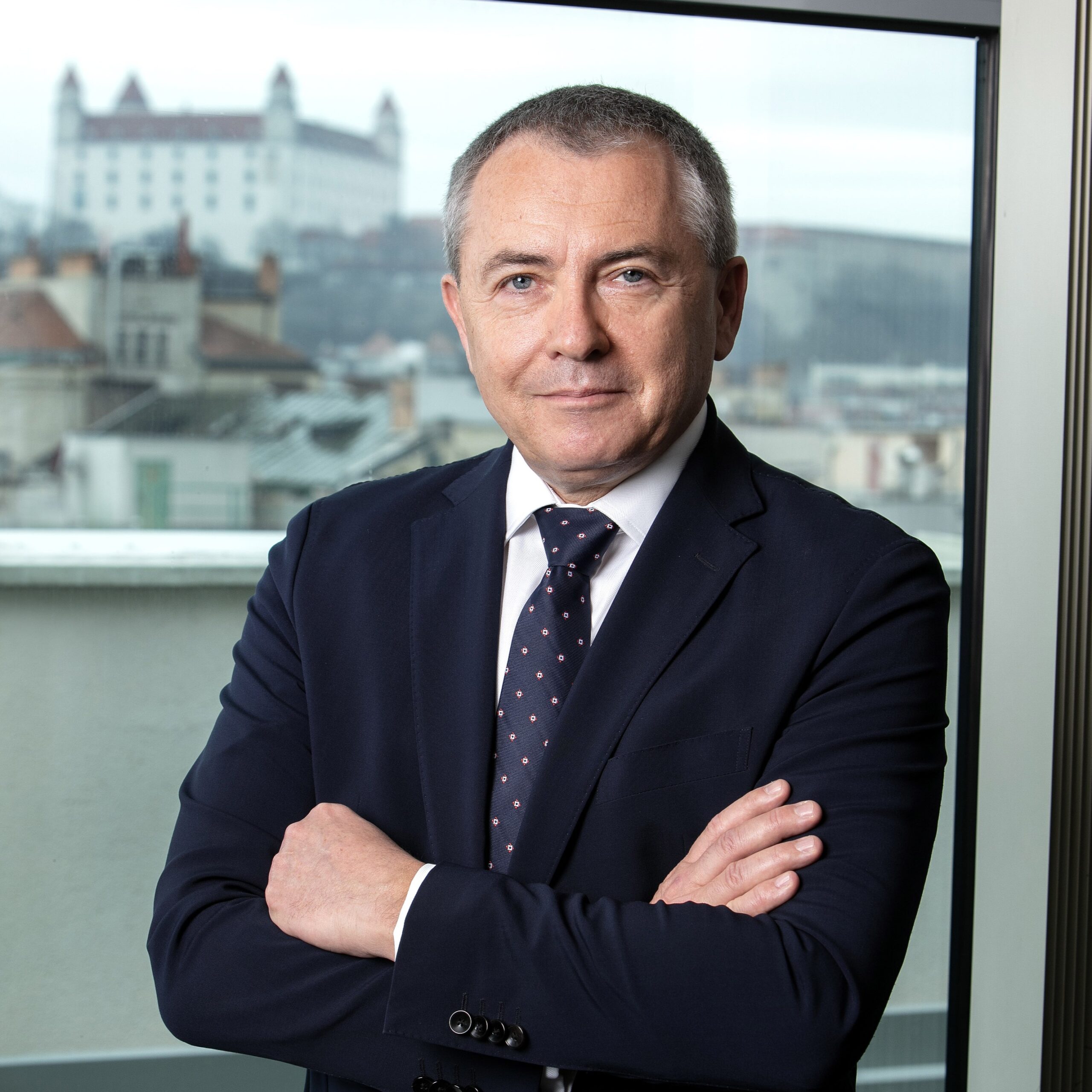
Igor Barat, Deputy CEO and Member of the Eximbanka Board, on the benefits of our membership in the Eurozone, global trends and challenges, Slovakia’s open economy, the importance of exports and Eximbanka’s role in supporting them.
You have worked for many years at the National Bank of Slovakia and you were also at the forefront of the process of introducing the euro. How do you perceive this journey today with hindsight and what changes do you think membership in the euro area has brought to Slovakia’s position in international trade?
The introduction of the euro was probably the third most important integration milestone for Slovakia, alongside its accession to the EU and entry into NATO. It has strengthened the country’s credibility, reduced exchange rate risk and facilitated trade and investment, which has improved the position of Slovak firms on European and global markets. From today’s perspective, it appears that the euro has increased the stability of the business environment and helped Slovakia better cope with economic turbulence. It has also made it easier for Slovak firms to integrate into European supply chains and to expand their presence on foreign markets.
You were appointed to the Board of EXIMBANKA SR in 2024. What expectations and goals did you accept this position with and what do you consider to be the most important priorities of this institution in terms of supporting Slovak exports?
I joined with the aim of strengthening the position of EXIMBANKA SR as a stable partner for exporters. The priority is to expand export financing and insurance instruments and to help companies enter new markets. It is also important to strengthen cooperation with the business sector and state institutions in order to make export support as effective and comprehensive as possible. Eximbank can play an important role, particularly where commercial financing faces limits or higher risk.
During your career you have also been involved in communicating economic issues to the public. How important do you think it is today to explain to the public the importance of exports, foreign trade and an open economy for Slovakia’s prosperity?
Explaining the importance of exports is very important today. I would even say that it is perhaps an integral part of raising people’s overall financial and economic literacy. The Slovak economy is largely based on foreign trade. The public should understand that an open economy makes a significant contribution to job creation and economic growth. Exports not only bring income to companies, but also promote innovation, technological development and the productivity of the whole economy. If a society better understands these contexts, it is easier to make strategic economic policy decisions.
The Slovak economy is one of the most open in the world, which makes it sensitive to global trade and geopolitical tensions. In your opinion, should the Slovak Republic strive for a certain degree of greater economic self-sufficiency, or on the contrary, is the way forward to push even harder for an open free trade system – for example, through the European Union and the conclusion of new free trade agreements?
Slovakia should remain an open economy, as open trade brings greater efficiency and wider opportunities for businesses and consumers. At the same time, however, it is prudent to strengthen economic resilience, for example by diversifying supply chains and export markets, ideally within the framework of cooperation in the European Union. The key is to strike a balance between openness and responsiveness to global economic or geopolitical shocks.
If you look at Slovak exports with a perspective of the next ten years – which global trends or changes do you think will be decisive for whether Slovakia can remain a competitive export economy?
In particular, technological innovation, digitalisation, green transformation and diversification of export markets will be crucial. The key will be whether Slovak companies can shift their production to higher added value. Changes in global supply chains and the pressure to reduce the energy and carbon intensity of production will also play an important role. It will also be important for Slovakia to see how its industrial structure adapts to technological change, especially in the automotive sector, which accounts for a significant share of exports.
If you had to name one thing that Slovakia should do to strengthen its position in international trade in the coming years, what would it be?
The most important thing is to invest in education, innovation and productivity. This is what will enable Slovak companies to compete internationally with products and services with higher added value. At the same time, it is important to strengthen cooperation between the academic environment and the business sector. A strong innovation capacity of the economy is one of the key prerequisites for long-term export success.
Eximbanka’s task is to support Slovak companies in establishing themselves on foreign markets, often in more difficult or risky territories. In which regions of the world do you see the greatest potential for Slovak exporters in the coming years?
Prospectively, I see especially markets in Southeast Asia, in parts of Africa and Latin America, but also in Central Asia and India, or even further afield, in the Far East. These are rapidly developing regions where the demand for technologies and industrial solutions in which Slovak companies have strong know-how is growing. At the same time, however, these are markets with a higher level of risk, where institutions such as Eximbanka play a key role. It is the combination of financing, insurance and expertise that can help Slovak companies take full advantage of these opportunities.
Author Filip Šandor
Source: export.sk