
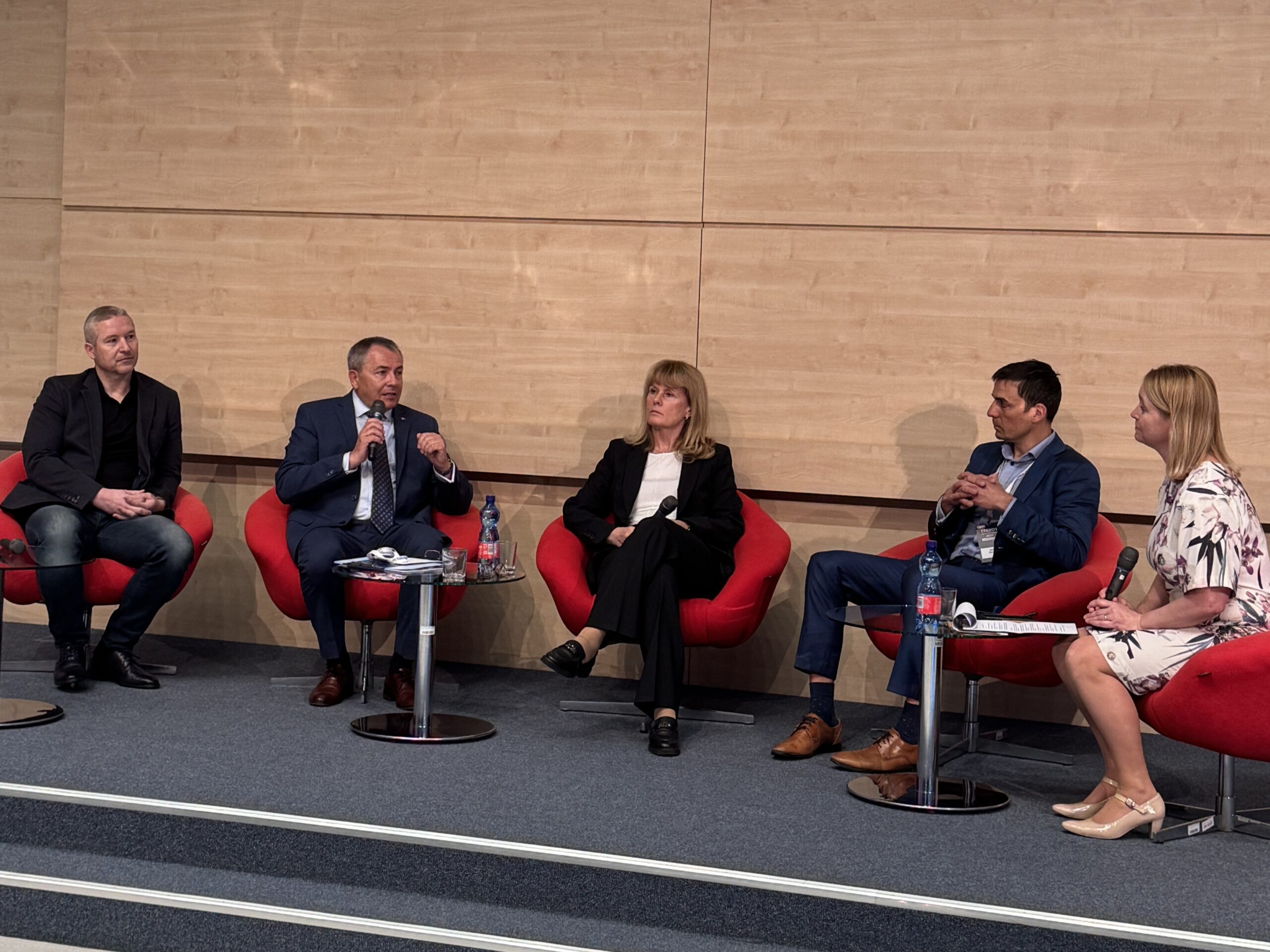
The Slovak economy is entering a period of gradual transformation driven by technological change, pressure for efficiency and a changing global environment. Igor Barát, Deputy Director General of Eximbanka, stated this at the Trends of Slovak Business 2026 conference in a panel discussion devoted to the future of industry.
According to him, one of the most significant trends that is changing the Slovak industry today is automation and robotization of production. Companies are being pushed towards it by a combination of labour shortages and growing pressure on productivity and cost efficiency. “Businesses have to adapt to global competition, which leads to faster adoption of technology. The result is higher productivity, but also a fundamental change in the structure of job positions,” Barat explained, adding that there is a growing demand for skilled workers at the expense of routine professions.
These changes are also reflected in the overall nature of the economy. Although Slovakia continues to build on a strong industrial base, especially in the automotive sector, it is gradually expanding into higher value-added segments. In addition to traditional sectors such as mechanical engineering, chemical or electrical engineering, IT services, technological solutions and electromobility are gaining importance. “The transformation is taking place, but in an evolutionary rather than radical way – the new segments are complementing the existing structure, not replacing it,” he added.
Similar dynamics can be seen in the export sector. It remains built on a strong industrial base, but is gradually diversifying towards technological and innovative solutions. Diversification – both sectoral and territorial – is becoming a key factor in the resilience of the economy in times of growing geopolitical risks and uncertainty in global markets.
Exporters’ expectations are also responding to the changing environment. While in the past the demand for financing or risk insurance dominated, today companies are increasingly looking for comprehensive solutions and support when expanding into new markets. “The context of business is changing – there is a growing emphasis on risk management and flexibility. Eximbanka is therefore naturally moving into the role of a strategic partner,” said I. Barát.
In this context, it appears that the problem is not a lack of financial resources, but rather the quality of the projects. “The capital is available, but there is a lack of sufficiently prepared and ambitious projects that can use it effectively,” he concluded.
In the long term, Slovak exports should move towards a higher level of technology and added value. In the short term, this means strengthening existing industries and expanding export markets; in the medium term, more emphasis on innovation, digitisation and services; and in the decade horizon, building a knowledge-based economy based on research, modern industry and energy resilience.
However, alongside a favourable regulatory and business environment, human capital remains a key condition for this transformation. The lack of skilled workers is the biggest obstacle to development: “The education system is not sufficiently responsive to the needs of the labour market. We have a good theoretical basis, but a weaker connection with practice and a lack of leadership skills,” he warned. At the same time, the situation is worsened by the outflow of talent abroad, which weakens the country’s innovation potential.
Despite these challenges, the Slovak industry has good prerequisites for further development. It has both the technological background and the ability to adapt, although the pace of change is still lagging behind the most advanced economies. It sees the greatest opportunities in the areas of technology, innovation and green transformation, while promising sectors include energy, electrical engineering, IT and defence. However, the ability of companies and the economy as a whole to adapt to new conditions will be essential for success: “The future will belong to those who can invest in people, innovate and respond quickly to change. Flexibility and quality of decision-making will be crucial,” concluded I. Barat.