
The energy sector, the railway industry, and new infrastructure contracts offer opportunities for expansion for both large and smaller companies
Serbia represents not only a market for Slovak companies but also a potential base for expanding business activities in the Western Balkans. Slovak firms operate here in traditional industrial sectors and are also involved in renewable energy projects. Further opportunities may arise from investments in infrastructure, industrial modernization, and preparations for EXPO 2027 in Belgrade.
Industry Holds Its Ground
Slovak companies operate in Serbia primarily in the engineering, railway, and automotive industries, as well as in the energy sector and tourism. Notable investment successes include projects for the manufacture and repair of rail vehicles in Subotica. Slovak companies have also become involved in renewable energy projects, including solar power plants, biogas, and biomass. Investments are directed toward several regions of the country. Historically,
they have been concentrated primarily in Vojvodina, around Bački Petrovac, but also in central Serbia, for example
in Smederevska Palanka.
According to Marián Stankovič of Eximbanka’s International Relations Department, the attractiveness of these locations is enhanced by transportation accessibility, industrial tradition, a skilled workforce, and existing supply chains. The Serbian Development Agency lists geographic location, labor availability, and access to foreign markets among the main investment advantages. Cultural
, and geographical proximity also make it easier for Slovak companies to operate, particularly in Vojvodina, where a large Slovak community resides.
Opportunities Are Growing
New opportunities for expansion are opening up in other sectors. Preparations for EXPO 2027 could serve as a catalyst.
in Belgrade and the Serbia 2027 investment program. According to Marián Stankovič, he sees Eximbanka potential, especially
in sectors where Slovak companies have strong technical expertise. “From the perspective of Eximbankas We see opportunities primarily in areas where Slovak companies have strong technical expertise, namely in the energy sector
“…in renewable energy, water and waste management, transportation and municipal infrastructure, industrial modernization, and digital solutions,” adds M. Stankovič. These opportunities are not reserved solely for large investors. Small and medium-sized enterprises can participate as suppliers of technologies and components
and specialized solutions. Participating in larger projects can help them gain international references
and establish new business relationships.
Risks must be managed
When entering the Serbian market, it is important to choose a local partner who is familiar with the conditions in the industry. Exporters should vet buyers, establish payment terms, and anticipate changes in the business environment. Trading therefore requires a thorough assessment of risks and preparedness for unforeseen circumstances. Eximbanka offers pre-export loans for the preparation and execution of contracts. Buyer credits enable foreign partners to finance the purchase of Slovak products and technologies. Export receivables insurance protects exporters against non-payment, and bank guarantees help them fulfill contractual terms.Martin Schaner, Director of the Trade Risk Insurance Department, outlines specific activities.: “We have credit lines totaling 1,190,000 euros for Serbia. These primarily cover supplies in the iron, steel, precious metals, and ferroalloy sectors, as well as in the agriculture and food production sectors.”
A bridge to other markets in the region
Serbia can serve as a starting point for Slovak companies to expand their operations in the region. Successfully completed projects in the country can serve as references when bidding for contracts in other Western Balkan countries and facilitate negotiations with new clients. When entering new markets, the ability to secure financing for transactions and mitigate associated risks also plays a key role. Eximbanka supports Slovak exporters through financial instruments, commercial and political risk insurance, and bank guarantees. The specific form of support depends on the nature of the project, the customer’s creditworthiness, and the terms of the relevant product.
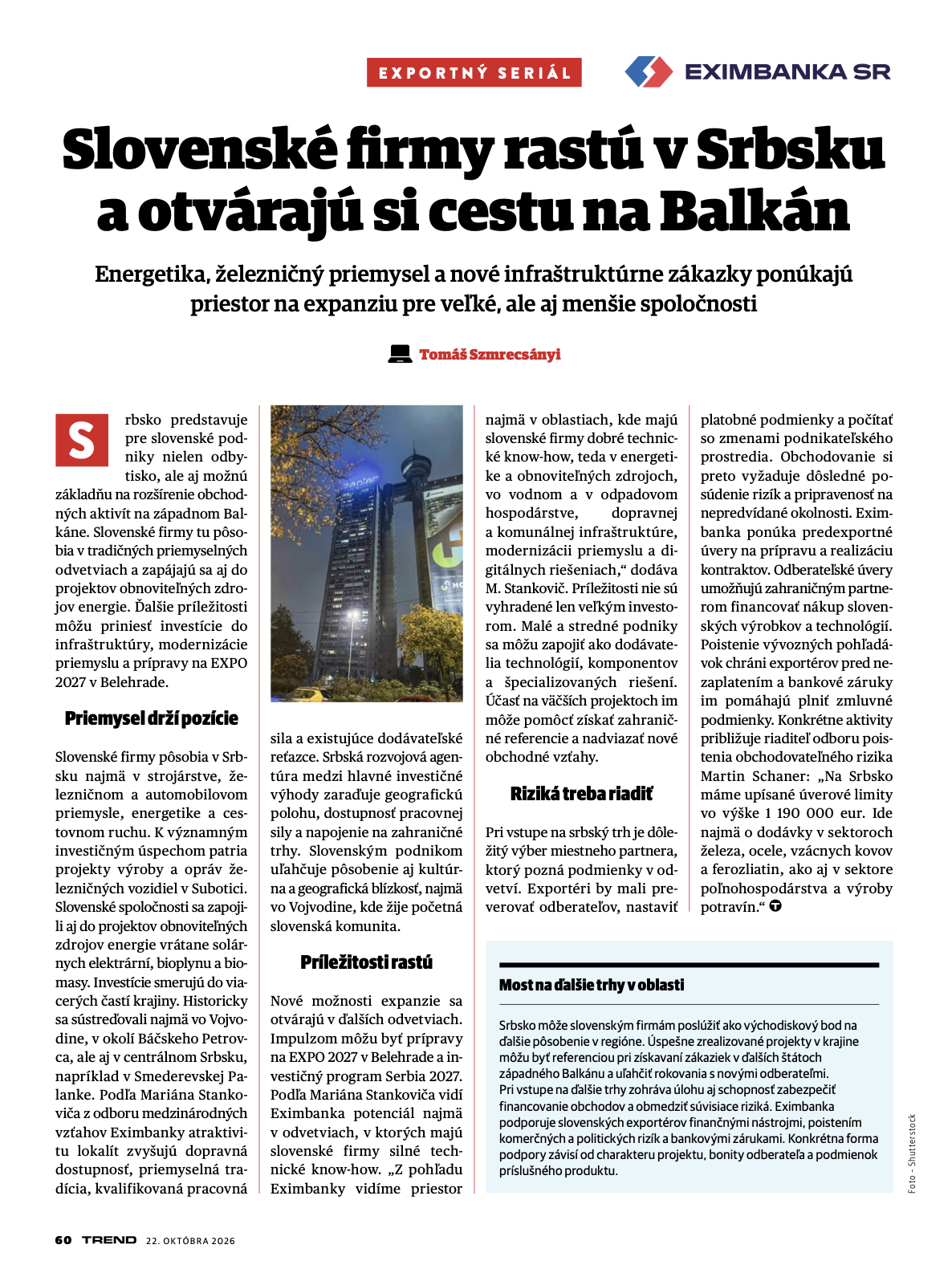
Photo – Shutterstock
Author: Tomáš Szmrecsányi
Source: TREND.sk