
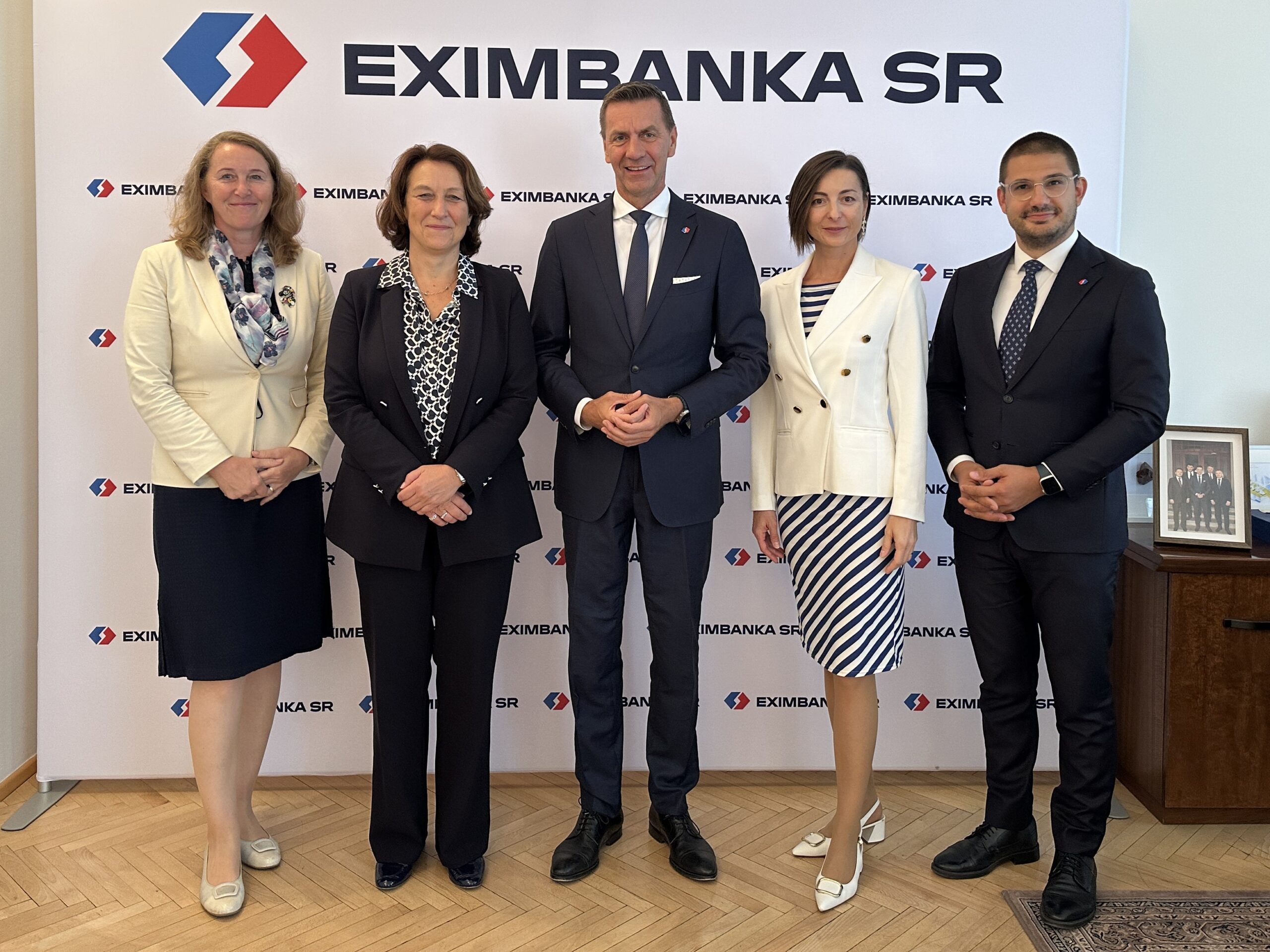
Eximbanka’s management held talks with representatives of the Organization for Economic Cooperation and Development (OECD) on the future development of rules governing state-supported export financing and their adaptation to changing conditions in global trade.
The meeting was attended by Marion Jansen, Director of Trade and Agriculture at the OECD, Silvia Gavorníková, Head of the OECD’s Export Credit and Competition Division, and Bronislava Chmelová, Ambassador and Permanent Representative of the Slovak Republic to the OECD. Eximbanka was represented at the meeting by CEO Rastislav Podhorec and Matúš Šársky, Director of the International Relations Department.
A key topic of the meeting was the further modernization of the OECD Arrangement on Officially Supported Export Credits. The OECD rules establish a common framework for the provision of officially supported export financing with the aim of ensuring fair competitive conditions. At the same time, they constitute the fundamental regulatory framework for the activities of export credit agencies, including Eximbanka.
In this area, Eximbanka represents the Slovak Republic in technical negotiations within the European Union and the OECD. It actively participates in discussions on topics of direct importance to Slovak exporters and the Slovak economy. These include, for example, linking export financing to development cooperation and the broader framework of rules that affect the ability of Slovak companies to compete for international projects.
“The OECD provides a unique platform for bringing partners together to exchange views, build trust and identify practical solutions to shared economic challenges, including export credit disciplines”, noted Marion Jansen, Director of Trade and Agriculture at the OECD.
The first phase of the rules’ modernization, adopted in 2023, brought about primarily financial and technical changes. The current second phase focuses on the broader question of whether the rules can keep pace with the new realities of global trade, growing geopolitical uncertainty, and intensifying competition from countries outside the traditional OECD framework.
Slovakia supports maintaining the fundamental principles of the OECD Agreement, while also emphasizing the need for sufficient flexibility and pragmatic solutions. The goal is to adapt the rules to the new reality of global trade without undermining open and rules-based trade, while ensuring that exporters from OECD countries are not systematically disadvantaged compared to their global competitors.
“For Slovakia, as a small and open economy, stable and predictable rules for export financing are extremely important. At the same time, however, they must reflect the reality of global competition. If these rules are too rigid for exporters from OECD countries compared to the conditions faced by their competitors, they may put them at a disadvantage when securing foreign contracts. Our ambition, therefore, is not to weaken the rules, but to set them in a way that protects fair competition while allowing our exporters to remain competitive,” said Rastislav Podhorec, CEO of Eximbanka.
The meeting also addressed the growing importance of government support for exports to economic security and the resilience of supply chains. In an environment of growing geopolitical uncertainty, export credit agencies can support the diversification of export markets and supply chains and help reduce excessive dependence on individual regions.
The meeting also confirmed the importance of regular dialogue between Eximbanka, the OECD, and the Slovak Mission to the OECD in shaping rules that directly affect the financing conditions for Slovak exports and the competitiveness of Slovak companies in foreign markets.