
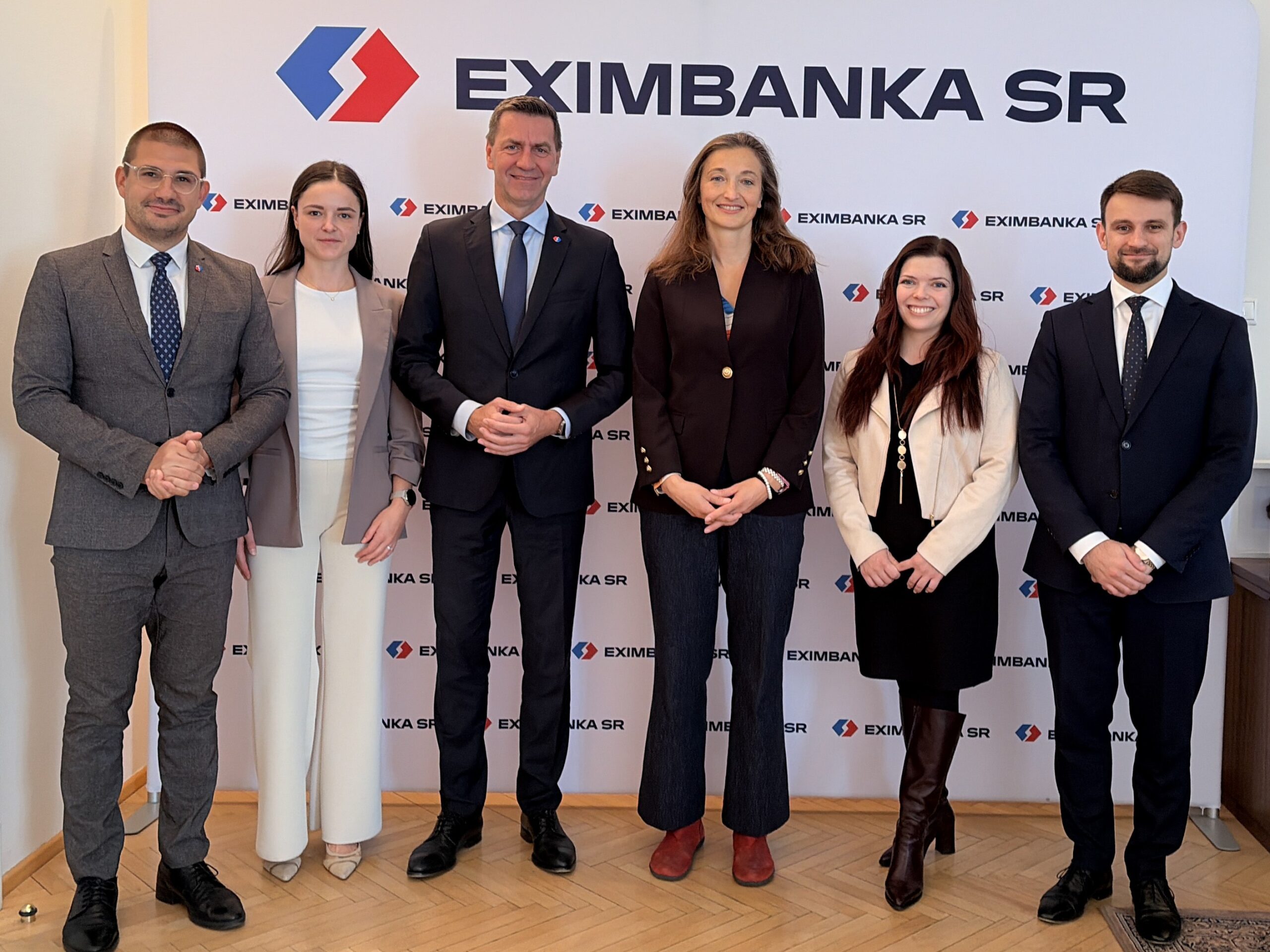
Progress in the preparation and implementation of investment projects in Ukraine, cooperation in utilizing European financial instruments, and other opportunities to support the country’s recovery were the main topics of today’s meeting between Eximbank representatives and a delegation from the European Commission. The delegation was led by Elena Višnar Malinovská, Head of the Ukraine Recovery and Accession Unit at the Directorate-General for Enlargement and Eastern Neighborhood. Representing Eximbanka at the meeting were Rastislav Podhorec, CEO and Chairman of the Bank’s Board; Matúš Šársky, Director of the International Relations Department; and Mária Líšková.
The discussion focused primarily on the preparation of projects under the Ukraine Investment Framework (UIF), a European investment framework aimed at mobilizing public and private investment for the reconstruction and modernization of Ukraine. Eximbanka, in cooperation with the European Commission and the Slovak Agency for International Development Cooperation (SAMRS), is participating in the preparation of a €101 million investment program aimed at the reconstruction and modernization of Ukraine’s energy infrastructure.
Eximbank officials praised the close cooperation with the relevant departments of the European Commission, which is making a significant contribution to advancing the preparatory and implementation processes. Eximbanka’s involvement in UIF projects is also part of the Slovak Republic’s broader effort to support Ukraine’s recovery and develop mutual economic cooperation. In this context, negotiations are also continuing on an intergovernmental agreement between Slovakia and Ukraine, which is intended to help create suitable conditions for the implementation of investment projects, including the resolution of related administrative, tax, and customs issues.
For Eximbanka, participation in the UIF also represents a significant step forward in the management and utilization of European financial resources. Preparing for the delegated management of EU funds requires the development of professional capacities and the establishment of new internal processes across multiple departments of the bank. The experience gained thus lays the groundwork for Eximbanka’s future involvement in other international development initiatives, including the European Union’s Global Gateway strategy.