
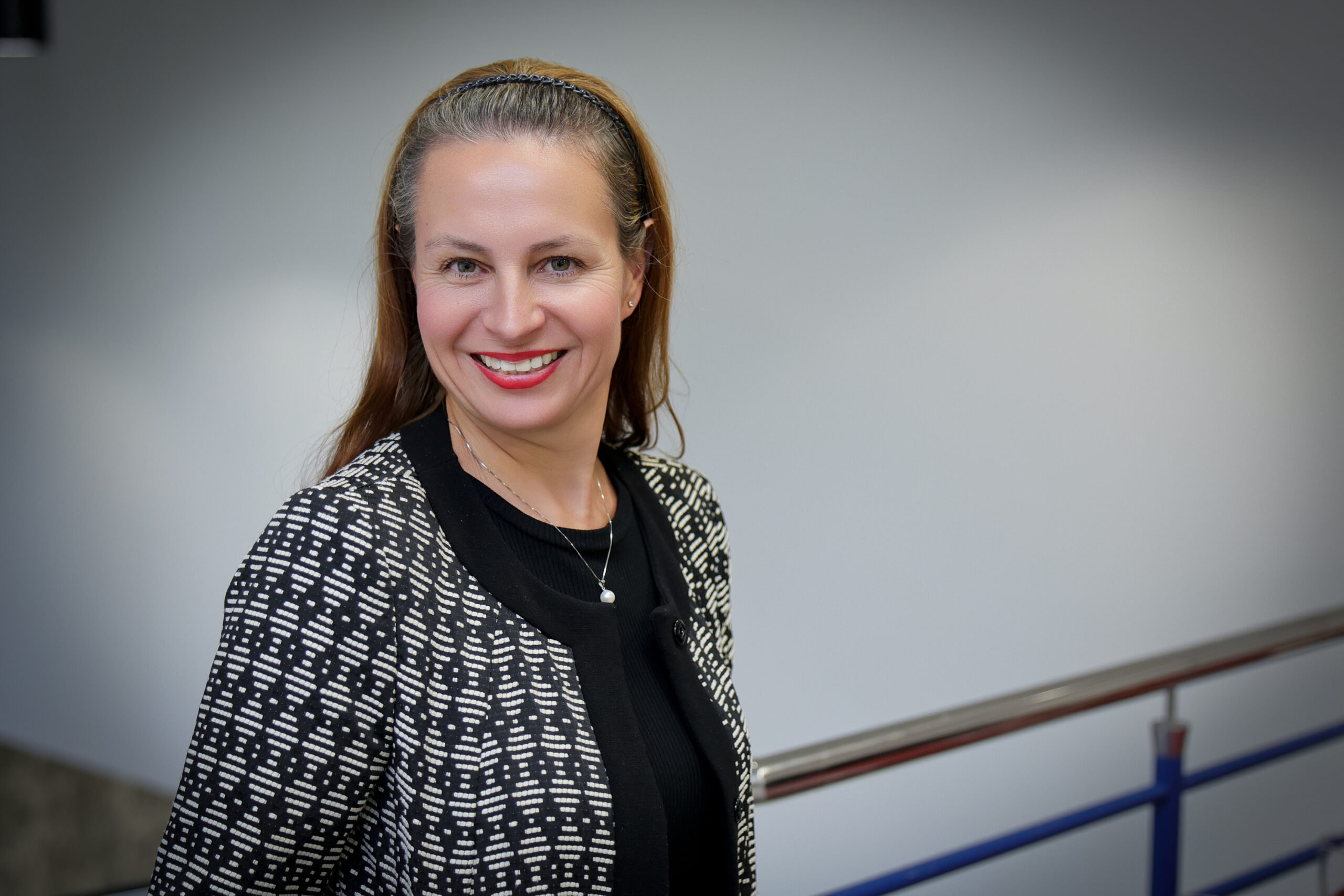
An interview with Zuzana Kaparová, Head of the EIB Group Office in Slovakia, on support for Slovak exporters, new financing opportunities, and areas where cooperation with Eximbanka can help Slovak companies grow and establish themselves abroad. She also discusses the potential in the energy sector, innovation, digitalization, and security and defense, as well as the opportunities that Ukraine’s reconstruction offers to Slovak companies.
1. What are the EIB’s priorities in Slovakia over the coming years?
The priority for the EIB Group, consisting of the European Investment Bank (EIB) and the European Investment Fund (EIF), in Slovakia is clear: stronger energy security, more modern infrastructure, more affordable housing, and greater support for security and defence-related investment. We are also focusing on support for the Slovak SMEs through unlocking new, more affordable sources of financing for them.
The EIB Group is already financing smarter electricity grids, safer transport and regional infrastructure. We are also interested in doing more with larger Slovak companies directly, especially in areas that strengthen competitiveness and resilience. Just as importantly, the EIB can combine financing with advisory support, so projects are not only funded, but also better prepared and faster to deliver.
2. How does the EIB view the role of national export credit agencies, such as Eximbanka?
The EIB Group sees Eximbanka as a very important partner especially when it comes to providing SME and Mid-Cap support, but also when it comes to supporting Ukraine`s economic resilience and in parallel creating new opportunities in the country for Slovak companies.
We benefit greatly from this partnership as Eximbanka is close to Slovak exporters and understands the local market. The value of this partnership is practical: companies get access to longer-term and more affordable financing for export contracts and investment, while the wider economy benefits through export growth stronger competitiveness, more secure jobs, protected incomes and healthier regional growth. For citizens, that matters because successful exporters support employment, supplier networks and tax revenues that help keep local communities strong.
3. Which areas do you see as the most promising for deepening cooperation between the EIB and Eximbanka in supporting Slovak exporters?
The strongest opportunities are in energy technologies, globally competitive industry, digital solutions, innovation, and in security and defence-related supply chains.
There is also a very real opportunity for Slovak companies to export more to Ukraine and to take part in reconstruction, especially in areas like transport, energy, equipment, technologies and services. That is exactly where a stronger EIB Group–Eximbanka partnership can help by reducing risk, mobilising more finance and giving Slovak firms the confidence to go after bigger opportunities.
4. Which EIB instruments can best support Slovak small and medium-sized enterprises in exporting?
For most SMEs, the most useful tools are EIB credit lines through local banks and promotional institutions including Eximbanka, because they bring longer maturities and better loan conditions than many firms could get on their own.
We also offer guarantees as a very important tools because they reduce risk for lenders and make it easier to finance companies that want to invest, grow or enter new markets.
For more innovative and faster-growing companies, EIB Group support can also include equity or risk capital through the EIF, which works with venture capital funds and other intermediaries to help promising firms scale up.
5. How do exporters make use of the EIB credit line that you have with Eximbanka?
In simple terms, exporters apply through Eximbanka, and Eximbanka can on-lend EIB resources to help finance their needs.
That can cover investment linked to foreign contracts, expansion plans, production capacity, operational needs, working capital or efforts to deal with supply-chain disruptions.
For companies, the benefit is straightforward: financing can be more accessible, longer-term and better priced, which makes it easier to grow abroad without putting too much strain on cash flow. It also gives firms more room to diversify markets and reduce their dependence on a small number of buyers or countries..
6. How can Slovak exporters better leverage EIB financing, particularly in the areas of innovation, digitalisation and technological development?
The best starting point is to come early with a serious investment plan and speak not only to banks or Eximbanka, but also to the EIB Group ecosystem around them.
On the EIF side, there are guarantee products specifically designed for innovation and digitalisation, which can lower financing costs, reduce collateral needs and extend maturities for SMEs and small mid-caps.
The EIF also supports equity and venture capital channels in Slovakia, which is important for start-ups and scale-ups that need growth capital rather than a traditional bank loan.
In short, the message to exporters is this: don’t think only in terms of a loan, think in terms of a package of financing, guarantees, equity support and advisory that can help a company move faster and grow smarter.
7. How has the EIB’s investment and risk policy changed in response to geopolitical challenges, such as disrupted supply chains?
The EIB Group has adapted to that new reality. Under President Nadia Calviño, the EIB Group has become more flexible and more focused on security, resilience and competitiveness, while still protecting its financial strength and high standards.
In practice, that means more support for energy independence, critical infrastructure, resilient supply chains and security and defence projects, including through dedicated credit lines and guarantees for SMEs.
The EIB’s message has been consistent: Europe is at a turning point, and investment policy has to respond to that with speed, reliability and a much stronger focus on strategic autonomy.
8. What cooperation models do you have with other export credit agencies that could also be applied in Slovakia?
There are several models that are highly relevant for Slovakia. One is classic co-financing, where the EIB and an export credit agency support the same transaction and make larger projects possible.
Another is risk-sharing, where the EIB or the EIF provides guarantees or counter-guarantees that free up capacity for export credit agencies and their banking partners to finance more deals.
The EIB Group is already developing exactly these kinds of structures in Europe, including export credit support linked to Ukraine and pilot counter-guarantee models that can be scaled up more broadly.
There are also examples with national institutions such as Finnvera in Finland, where EIB risk-sharing helps unlock larger lending volumes on better terms for companies.
For Slovakia, that means the EIB Group and Eximbanka could gradually move from a simple credit-line relationship to a broader toolbox: co-financing, guarantees, counter-guarantees and special schemes for strategic sectors or priority export markets.
9. Which sectors of the Slovak economy do you consider the most attractive for future EIB support?
Energy is at the top of the list, especially electricity grids, renewables, energy efficiency and projects that strengthen security of supply.
Transport and regional infrastructure are also very important, because better rail, roads, bridges and urban services improve daily life and make Slovakia a more attractive place to invest and do business.
Housing is another area with clear potential, not only for financing but also for advisory, as shown by the work already done in Bratislava on affordable rental housing.
The EIB Group also sees strong potential in innovative companies, digitalisation, advanced manufacturing and a larger role for the corporate sector, which is already visible in the Bank’s major support for ZSE.
And given the new geopolitical environment, security and defence-related supply chains are becoming a much more important area for future support than they were a few years ago.
10. What makes a good leader?
A good leader sets a clear direction when the world is changing fast. A good leader also listens, builds partnerships and gives people a sense of stability and trust even in uncertain times. For me, leadership is not about sounding strong, but about being reliable, bringing people together and staying focused on real impact for citizens and businesses.
Thank you for the interesting interview.
Photo: Lukáš Klčo