
Georgia could serve as a base for expansion into the broader Caucasus and Central Asian regions
This Caucasus country is transforming from an exotic destination into a real business opportunity for Slovak companies. Georgia combines a low administrative burden, a favorable tax system, and a strategic location at the crossroads of Europe and Asia. Eximbanka has already supported exporters’ projects here totaling more than 50 million euros, and interest is growing. For companies seeking new markets with growth potential, now is the right time to enter the market and gain a competitive edge.
The Landscape on the Horizon
Georgia has long remained off the radar of Slovak entrepreneurs, but this is changing. It has undergone reforms to its business environment and is now one of the easiest places to start a business in the post-Soviet space. The legislation is straightforward, the tax burden is low, and there is less bureaucracy compared to European markets. Companies appreciate the flexibility of the local market and the affordable labor force. They realize that success depends on local knowledge and established relationships. It is not a market where you can simply arrive with a product and wait for customers. “There are experienced investors operating there who are firmly established in this territory and have a track record of successful projects,” says Tomáš Kuruc, director of the Structured Finance Department.
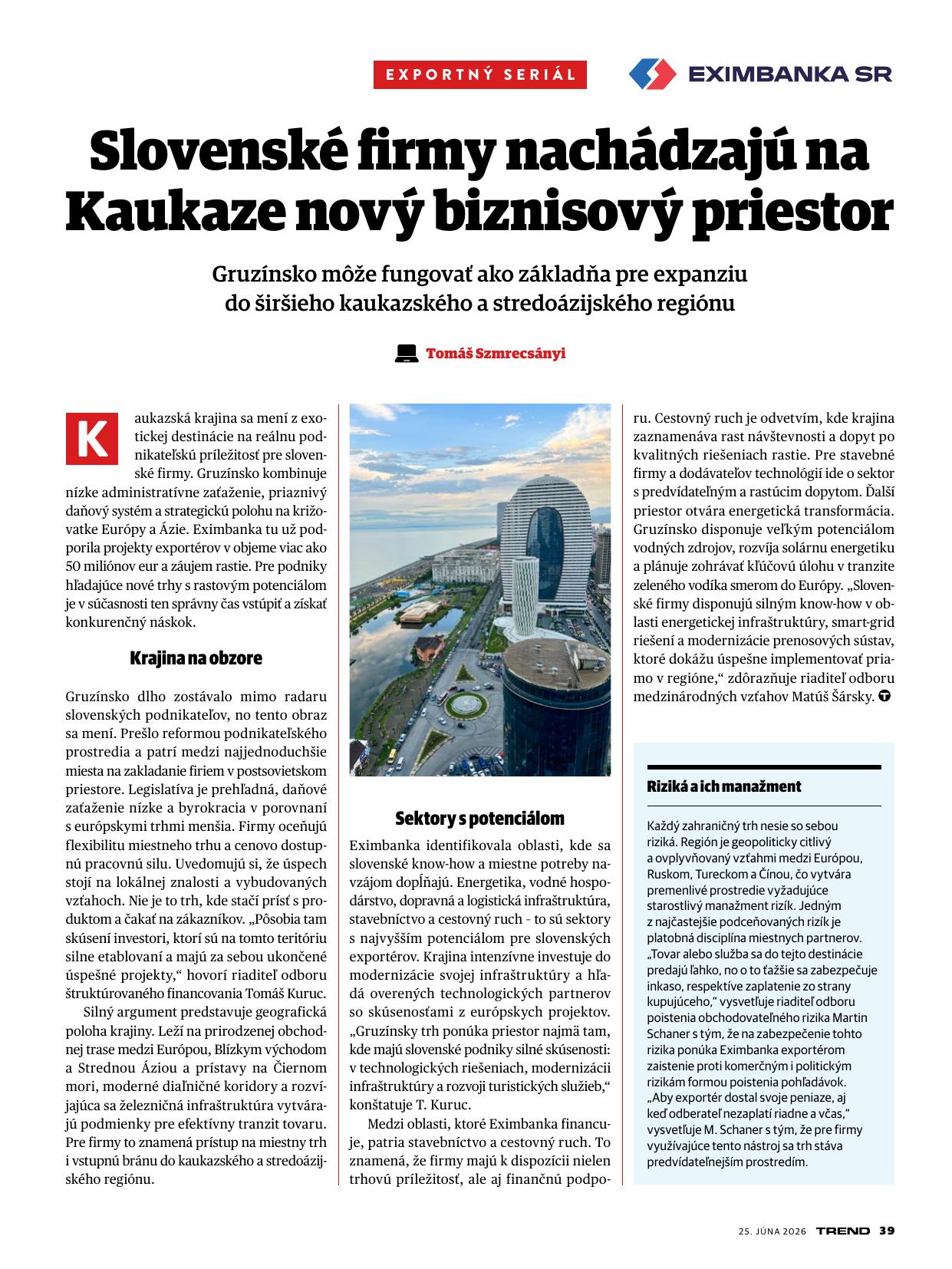
The country’s geographic location is a strong selling point. It lies on a natural trade route between Europe, the Middle East, and Central Asia, and its Black Sea ports, modern highway corridors, and developing railway infrastructure create the conditions for efficient transit of goods. For companies, this means access to the local market as well as a gateway to the Caucasus and Central Asia.
Sectors with potential
Eximbanka has identified areas where Slovak expertise and local needs complement each other. Energy, water management, transportation and logistics infrastructure, construction, and tourism—these are the sectors with the highest potential for Slovak exporters. The country is investing heavily in modernizing its infrastructure and is seeking proven technology partners with experience in European projects. “The Georgian market offers opportunities particularly in areas where Slovak companies have strong expertise: technological solutions, infrastructure modernization, and the development of tourism services,” notes T. Kuruc.
The sectors that Eximbanka finances include construction and tourism. This means that companies have access not only to market opportunities but also to financial support. Tourism is a sector where the country is seeing an increase in visitor numbers and growing demand for high-quality solutions. For construction companies and technology suppliers, this is a sector with predictable and growing demand. The energy transition opens up further opportunities. Georgia has significant hydropower potential, is developing solar energy, and plans to play a key role in the transit of green hydrogen to Europe. “Slovak companies possess strong expertise in energy infrastructure, smart grid solutions, and the modernization of transmission systems, which they can successfully implement directly in the region,” emphasizes Matúš Šársky, director of the International Relations Department.
Risks and Their Management
Every foreign market carries risks. The region is geopolitically sensitive and influenced by relations between Europe, Russia, Turkey, and China, creating a volatile environment that requires careful risk management. One of the most frequently underestimated risks is the payment discipline of local partners. “It’s easy to sell goods or services to this destination, but it’s all the more difficult to ensure collection—that is, payment by the buyer,” explains Martin Schaner, director of the Trade Risk Insurance Department, noting that to hedge against this risk, Eximbanka offers exporters protection against both commercial and political risks in the form of receivables insurance. “So that the exporter receives their money even if the buyer fails to pay properly and on time,” explains M. Schaner, noting that for companies using this tool, the market becomes a more predictable environment.
Author:Tomáš Szmrecsányi
Source: TREND.sk