
Slovakia has a lot to offer. The energy sector, digitalization, and the modernization of agriculture are creating new business opportunities
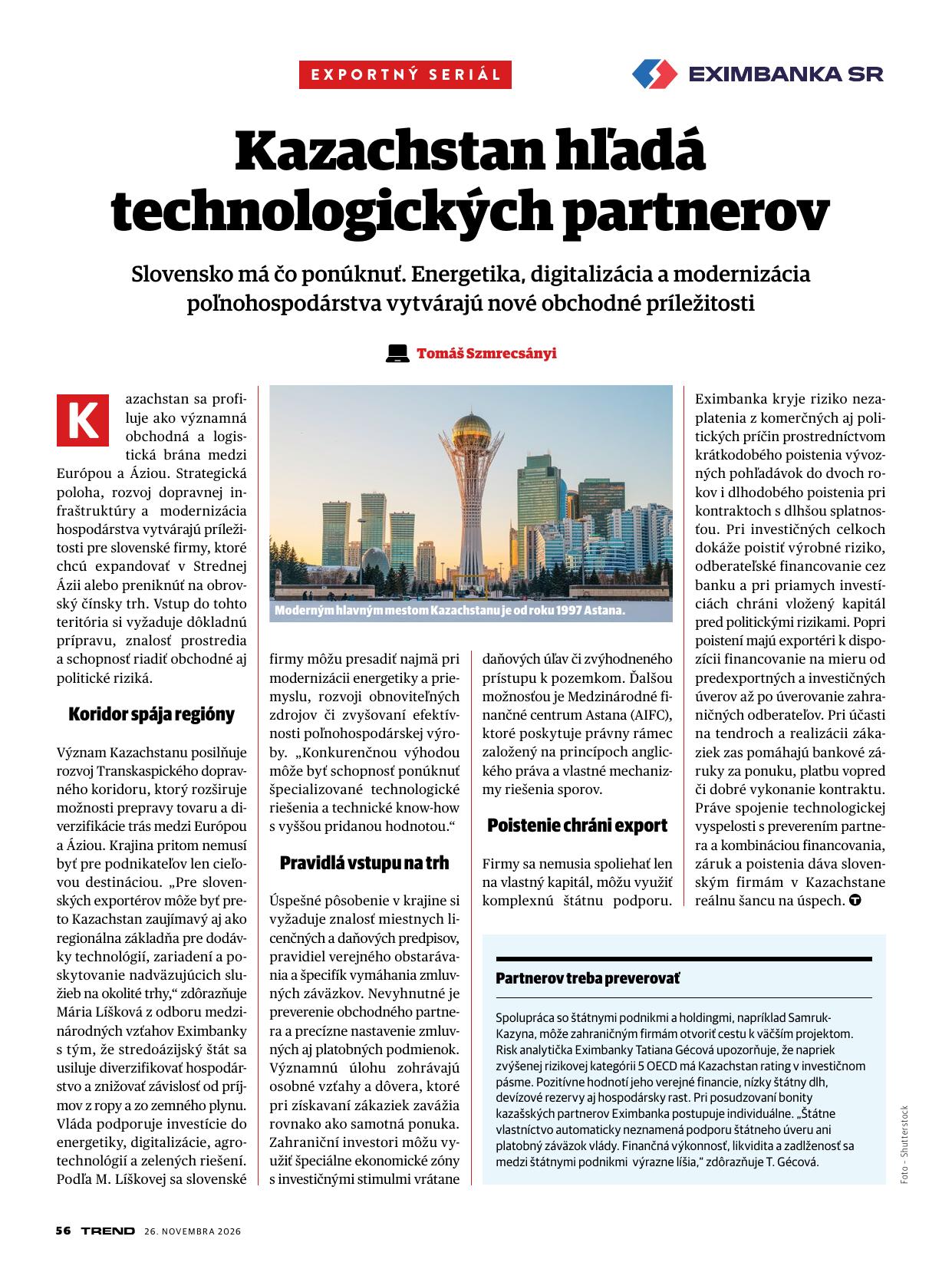
Kazakhstan is emerging as a major trade and logistics gateway between Europe and Asia. Its strategic location, the development of transportation infrastructure, and the modernization of its economy are creating opportunities for Slovak companies looking to expand into Central Asia or enter the vast Chinese market. Entering this market requires thorough preparation, knowledge of the environment, and the ability to manage both business and political risks.
The corridor connects regions
Kazakhstan’s importance is bolstered by the development of the Trans-Caspian Transport Corridor, which expands opportunities for the transport of goods and the diversification of routes between Europe and Asia. At the same time, the country need not be merely a destination for businesses. “For Slovak exporters, Kazakhstan may therefore also be of interest as a regional hub for supplying technology and equipment and providing related services to neighboring markets,” emphasizes Mária Líšková from Eximbank’s International Relations Department, noting that the Central Asian country is striving to diversify its economy and reduce its dependence on oil and natural gas revenues. The government supports investments in energy, digitalization, agrotechnology, and green solutions. According to M. Líšková, Slovak companies can make a name for themselves particularly in the modernization of the energy sector and industry, the development of renewable energy sources, and increasing the efficiency of agricultural production. “A competitive advantage could be the ability to offer specialized technological solutions and technical know-how with higher added value.”
Market Entry Rules
Successful business operations in a country require knowledge of local licensing and tax regulations, public procurement rules, and the specifics of enforcing contractual obligations. It is essential to vet business partners and carefully define contractual and payment terms. Personal relationships and trust play a significant role; when winning contracts, they carry as much weight as the bid itself. Foreign investors can take advantage of special economic zones offering investment incentives, including tax breaks and preferential access to land. Another option is the Astana International Financial Center (AIFC), which provides a legal framework based on the principles of English law and its own dispute resolution mechanisms.
Insurance protects exports
Companies do not have to rely solely on their own capital; they can take advantage of comprehensive government support. Eximbanka covers the risk of non-payment due to both commercial and political reasons through short-term export receivables insurance for up to two years, as well as long-term insurance for contracts with longer payment terms. For investment projects, it can insure production risk and buyer financing through a bank, and for direct investments, it protects invested capital against political risks. In addition to insurance, exporters have access to customized financing ranging from pre-export and investment loans to financing for foreign buyers. When participating in tenders and executing contracts, bank guarantees for bids, advance payments, and contract performance provide additional support. It is precisely this combination of technological sophistication, partner vetting, and a mix of financing, guarantees, and insurance that gives Slovak companies in Kazakhstan a real chance of success.
Partners must be vetted
Cooperation with state-owned enterprises and holding companies, such as Samruk-Kazyna, can open the door for foreign firms to larger projects. Eximbank risk analyst Tatiana Gécová points out that despite its elevated OECD Risk Category 5, Kazakhstan has an investment-grade rating. She views its public finances, low public debt, foreign exchange reserves, and economic growth positively. Eximbanka assesses the creditworthiness of Kazakh partners on a case-by-case basis. “State ownership does not automatically imply state credit support or a payment obligation on the part of the government. Financial performance, liquidity, and indebtedness vary significantly among state-owned enterprises,” emphasizes T. Gécová.
Author: Tomáš Szmrecsányi
Source: TREND.sk