
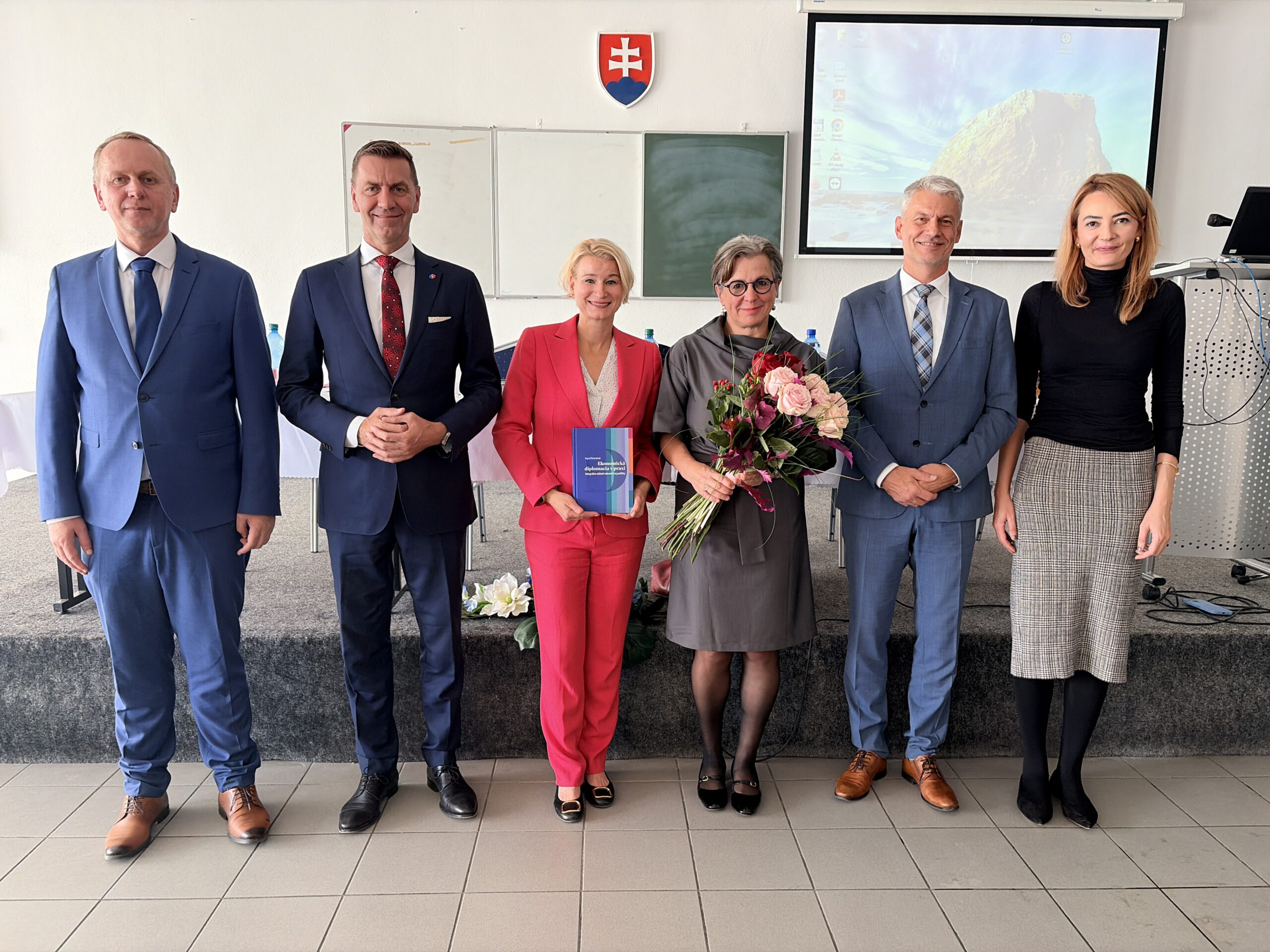
The role of economic diplomacy in promoting Slovak exports, its response to changing conditions in international trade, as well as the connection between academic education and the needs of diplomatic practice, were the main topics of a panel discussion held on October 7, 2026, at the Faculty of International Relations of the University of Economics in Bratislava.
The discussion brought together representatives from academia and experts with practical experience in the fields of diplomacy and international economic relations. Participants included Peter Terem, Vice Rector for Science and Research at Matej Bel University in Banská Bystrica, Hana Kováčiková, Vice Dean of the Faculty of Law at Comenius University in Bratislava and Director of the Karol Rybárik Diplomatic Academy, Rudolf Kucharčík, Dean of the Faculty of International Relations at the University of Economics in Bratislava; and Ingrid Brocková, Ambassador and former State Secretary of the Ministry of Foreign and European Affairs of the Slovak Republic.
A significant portion of the discussion focused on linking university education to the demands of diplomatic practice. Participants addressed issues related to the training of future diplomats, the development of their professional and practical skills, as well as the need to respond to new challenges posed by the changing international political and economic environment.
Eximbanka was represented at the event by its CEO, Rastislav Podhorec, who brought to the discussion the perspective of an institution directly involved in supporting Slovak exports. He addressed the current structure and functioning of economic diplomacy, its role in creating favorable conditions for Slovak businesses to operate in foreign markets, as well as the importance of coordination among the various actors involved in supporting foreign trade.
In an environment of growing geopolitical uncertainty, changing trade rules, and increased demands on financing and risk management, economic diplomacy is taking on ever-greater significance. In addition to opening up new trade opportunities, it is also important for strengthening trust among trading partners, removing barriers, and creating a stable framework for long-term economic relations. From Eximbanka’s perspective, it is therefore crucial that diplomatic activities be accompanied by concrete tools to support exporters—primarily financing, insurance, and bank guarantees—which help Slovak companies enter new markets, fulfill foreign contracts, and mitigate the risks of international trade.
An important part of this effort is also cooperation with foreign export credit agencies, international financial institutions, and other partners. It is precisely the integration of diplomatic contacts with financial and insurance instruments that makes it possible to turn business opportunities into concrete export projects.
The event also included a presentation of the book *Economic Diplomacy in Practice: An Integral Part of Foreign Policy* by Ingrid Brocková. In it, the author draws on her many years of experience in the diplomatic service and describes the process of shaping Slovak economic diplomacy, its role within the foreign policy framework, and her experiences with its practical implementation. The publication also offers insight into its current potential, identifies areas for further development, and provides recommendations for more effectively promoting Slovakia’s economic interests abroad.
The event provided a forum for bringing together academic knowledge, diplomatic experience, and the needs of the business world. At the same time, it served as a reminder that effective economic diplomacy is the result of cooperation between the government, educational institutions, and organizations that support the international activities of Slovak companies.